




Georgia Drug Trafficking vs. Distribution Laws
Georgia's drug laws create confusion that prosecutors exploit. Many clients don't realize that possession of threshold amounts automatically triggers trafficking charges, regardless of whether you intended to sell anything.
Under Georgia's Drug Trafficking Act (O.C.G.A. § 16-13-31), the quantity alone determines the charge. Having 28 grams of cocaine makes you a trafficker in the eyes of the law, even if you never sold a single gram.

Drug Distribution Charges
Distribution charges require proof that you actually sold, delivered, or gave drugs to another person. Prosecutors must establish:
- Actual transfer of controlled substances
- Knowledge of the substance's illegal nature
- Intent to distribute (not for personal use)
Penalties for distribution:
#details_start
- Schedule I or II Narcotics:
- First offense: 5 to 30 years imprisonment.
- Second or subsequent offense: 10 to 40 years, or potentially life imprisonment.
- Schedule III, IV, or V Drugs:
- First offense: 1 to 10 years imprisonment.
- Second or subsequent offense: 1 to 20 years imprisonment.
#details_end
Drug Trafficking by Quantity
Trafficking charges are triggered solely by weight thresholds, regardless of intent:
#details_start
CRITICAL: These are mandatory minimums. Judges cannot impose lighter sentences regardless of circumstances, criminal history, or personal hardship.
#details_end
Federal vs. State Drug Prosecutions
Understanding jurisdiction determines your entire defense strategy. Federal cases carry harsher penalties and different procedural rules that demand specialized representation.
When Federal Prosecution Applies
Federal agencies pursue cases involving:
- Multi-state operations or border crossings
- Large quantities triggering federal thresholds
- Organized criminal enterprises or conspiracy charges
- Federal property (airports, post offices, federal buildings)
- Wiretaps, surveillance, or task force investigations
Federal Mandatory Minimums (21 U.S.C. § 841)
Federal sentences require serving 85% minimum with no parole:
- Cocaine (500g-5kg): 5-40 years
- Cocaine (5kg+): 10 years to life
- Heroin (100g-1kg): 5-40 years
- Heroin (1kg+): 10 years to life
- Methamphetamine (50g-500g): 5-40 years
- Methamphetamine (500g+): 10 years to life
Northern District of Georgia
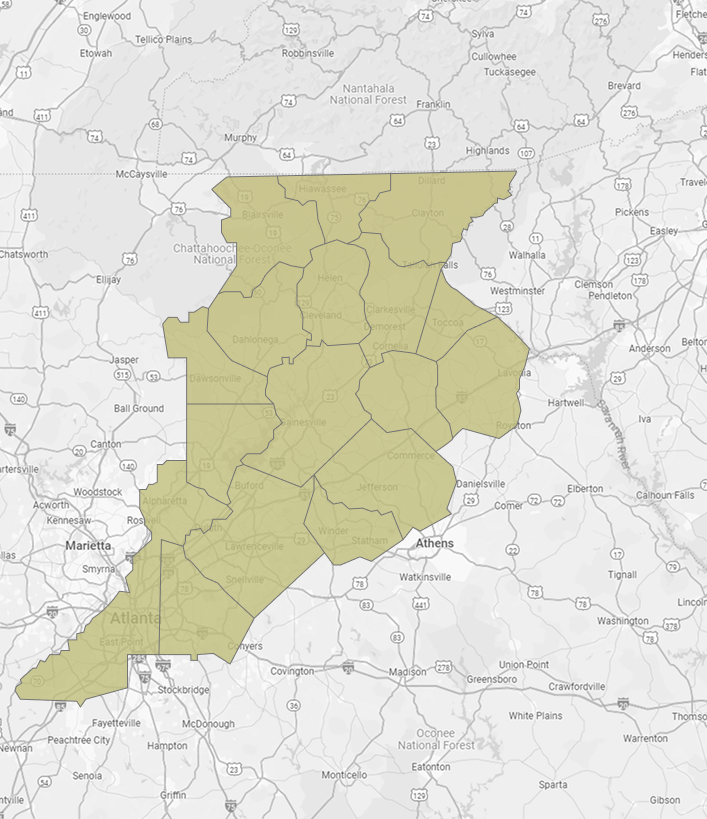
Federal cases in Northeast Georgia are prosecuted in the Northern District, with courthouses in Atlanta and Gainesville. These prosecutors have unlimited resources and specialized drug crime units.
#cta_start
Federal or State — We Know Both Systems
Our attorneys have prosecuted in state court and federal court and have advanced knowledge of the procedures in both legal systems. You need someone who knows how both systems work when your freedom is on the line.
#cta_end
Drug Conspiracy Charges — the Net Widens
Conspiracy charges allow prosecutors to sweep in everyone connected to drug operations, even peripherally. You don't need to touch drugs to face decades in prison.
Elements of Drug Conspiracy
Prosecutors must prove five elements beyond a reasonable doubt:
- Agreement: Two or more people agreed to commit drug crimes.
- Knowledge: You knew the agreement existed.
- Intent: You intended to participate in the illegal plan.
- Overt act: Someone took a step toward completing the crime.
- Federal jurisdiction: The conspiracy affected interstate commerce.
How Conspiracy Charges Expand Cases
Real conspiracy cases often involve:
- Drivers who transported drugs without knowing the contents.
- Property owners whose land was used for operations.
- Money handlers who processed cash from sales.
- Family members who provided minor assistance.
- Associates who knew about but didn't participate in operations.
Conspiracy Penalties Stack
Conspiracy carries the same penalties as the underlying drug crimes. If you're charged with trafficking 400 grams of cocaine (25-year mandatory minimum) and conspiracy to traffic, both charges proceed independently with potential consecutive sentences.

Defense Strategies That Challenge Drug Charges
#spoilers_start
Fourth Amendment Violations
Illegal search and seizure remains the most effective defense in drug cases. Law enforcement routinely oversteps constitutional boundaries during investigations.
Common search violations include:
- Warrantless searches without probable cause or exigent circumstances
- Exceeding the scope of valid search warrants
- Pretextual traffic stops without reasonable suspicion
- Coercive consent obtained through intimidation
- Failure to knock and announce during warrant execution
Challenging Drug Weight and Testing
Laboratory analysis isn't infallible. We demand forensic accountancy and challenge every aspect of drug testing.
Testing challenges include:
- Demanding live testimony from laboratory analysts
- Challenging chain of custody documentation
- Questioning testing procedures and equipment calibration
- Attacking sampling methods and contamination issues.
- Disputing purity calculations and weight measurements
Lack of Knowledge Defense
Many drug cases involve shared vehicles, residences, or property where multiple people have access. Prosecutors must prove you knew drugs were present.
Knowledge defenses apply to:
- Rental cars or borrowed vehicles containing drugs
- Shared apartments or houses where others live
- Storage units or properties with multiple access points
- Luggage or packages you didn't pack personally
Entrapment and Government Misconduct
Law enforcement sometimes crosses the line from investigation to inducement. Entrapment occurs when government agents induce criminal conduct that defendants wouldn't otherwise commit.
Entrapment defenses include:
- Confidential informants who initiated criminal plans
- Undercover operations that created artificial markets
- Government provision of resources necessary for crimes
- Pressure or coercion to participate in drug transactions
Miranda Rights and Constitutional Violations
Post-arrest statements often provide the strongest evidence against defendants. We examine every interrogation for constitutional violations.
Statement challenges include:
- Custodial interrogation without Miranda warnings
- Continued questioning after invoking the right to remain silent
- Coercive interrogation techniques or psychological pressure
- Statements obtained during illegal detention
- Promise of leniency or threats to obtain admissions
Challenging Confidential Informants
Informants receive cash payments, reduced charges, or other benefits for their cooperation. These incentives create powerful motivations to lie or exaggerate.
Informant challenges include:
- Demanding disclosure of payment amounts and benefits received
- Examining an informant’s criminal history and credibility
- Challenging the reliability of the information provided
- Attacking entrapment and government misconduct
- Cross-examining informants about motivations to fabricate
#spoilers_end
Hidden Consequences Beyond Prison
#spoilers_start
Professional License Impact
Drug convictions trigger automatic suspension or revocation proceedings for numerous professional licenses:
- Medical professionals: Nursing, pharmacy, and medical licenses.
- Legal professionals: Attorney licenses and paralegal certifications.
- Education: Teaching certificates and school employment.
- Transportation: Commercial driving licenses and aviation certificates.
- Financial: Real estate, insurance, and securities licenses.
Immigration Consequences
Drug convictions create severe immigration consequences for non-citizens:
- Deportation proceedings for most drug convictions.
- Inadmissibility for future immigration applications.
- Loss of legal status for permanent residents.
- Ineligibility for naturalization to citizenship.
Driver's License Suspension
Georgia automatically suspends driver's licenses for drug convictions:
- First conviction: 6 months suspension.
- Second conviction: 1-year suspension.
- Third conviction: 2-year suspension.
Limited driving permits may be available for work, school, and treatment purposes.
Federal Benefits and Housing
Drug convictions affect federal assistance eligibility:
- Student financial aid suspension for drug convictions.
- Public housing ineligibility for families with drug convictions.
- SNAP benefits restrictions for drug trafficking convictions.
- Federal employment security clearance issues.
#spoilers_end
Drug Trafficking Carries 25 Years Mandatory — Don't Wait to Get Help
Former prosecutor Blake Poole and former judge Matthew Leipold combine insider courthouse knowledge with aggressive defense tactics. We know how the state builds these cases because we've done it ourselves.





.avif)