April 3, 2026
By Blake A.Pool
Free Consultations
|
24/7 for Emergency Help
.webp)
April 6, 2026
By Blake A. Poole
Facing criminal charges can feel like the ground dropped out from under you, especially when you don't have a prior record and weren't expecting to end up in the criminal justice system. But in many cases, a conviction isn't the only path forward.
If you or someone you know is dealing with pending charges, a Georgia criminal defense attorney can help you explore alternatives like the Georgia pretrial diversion program, which may allow you to avoid a criminal record entirely. This blog covers everything you need to know about how these programs work, who qualifies, what to expect, and where the limitations lie.
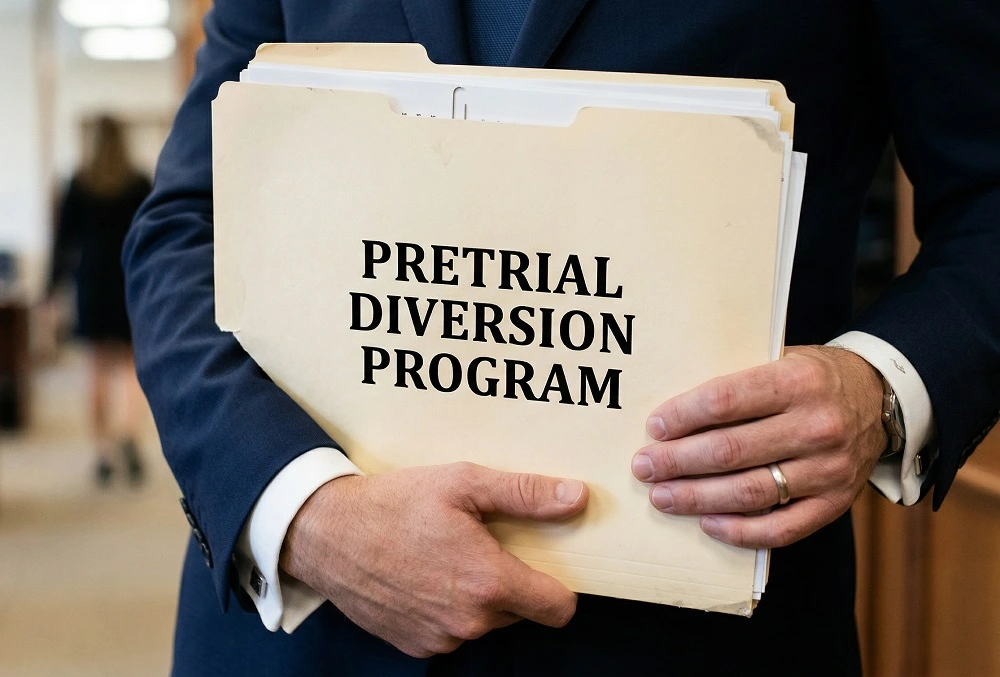
A pretrial diversion program is a formal alternative to traditional prosecution. Rather than proceeding through court, an eligible defendant agrees to complete a set of requirements, and in return, the prosecuting attorney agrees to dismiss the charges upon successful completion.
The program exists because Georgia law recognizes that not every offense requires a conviction. First-time offenders who make a single mistake (and haven't previously been arrested or convicted) often stand to benefit more from accountability and rehabilitation than from jail time or a permanent mark on their record.
The Georgia pretrial diversion program is created pursuant to O.C.G.A. §15-18-80, which authorizes prosecuting attorneys to establish pretrial intervention and diversion programs. Because this is not a statewide law that applies uniformly across every court, the specifics vary by county and jurisdiction. Some courts have structured, well-established programs, while other jurisdictions simply do not permit pretrial diversion at all.
The contrast with going through standard court proceedings is significant. Where traditional prosecution can result in a conviction, a sentence, and a permanent record, diversion offers a structured exit that leaves the defendant's record intact.
The key advantage is simple: successfully complete the program, and the case is dismissed. No conviction, no permanent criminal record, and in most cases, your records can be restricted afterward.
Eligibility criteria vary by county, but most programs in Georgia share a common baseline. The district attorney's office or prosecutor reviews each application individually, taking multiple factors into account.
Most programs are typically offered to defendants who meet the following criteria:
Note that a minor prior traffic violation typically won't disqualify you. Some counties will also allow participation for defendants who were previously arrested but never convicted, though this varies.
When evaluating a case, the prosecuting attorney typically weighs several factors, including:
Because each case is reviewed on its own merits, don't assume you're automatically ineligible just because your situation seems complicated. An experienced attorney familiar with the county in which you've been charged can often identify exceptions and make a case for your inclusion.
Each court designs its own individualized program, but most Georgia diversion programs share a core set of requirements that participants must complete during the supervision period.
Programs typically run six to nine months and may require participants to:
Once you enter the program, a diversion coordinator from the district attorney's office monitors your compliance throughout the program. If you meet all requirements by the end of the program, the judge signs a dismissal order, and your charges are formally dismissed.
Failing to meet the conditions of your diversion agreement has real consequences. If you're terminated from the program (whether for a program violation, a new arrest, or non-compliance), the charges return to the assigned court for prosecution. Your case moves forward as if the diversion never happened, and the prosecutor is no longer bound by the original agreement.
This is why having legal representation from the start matters. An attorney can help you understand exactly what's required and set you up to meet those conditions without missteps.

The application process is more involved than many people expect, and in most counties, you cannot apply on your own.
The process requires patience and follow-through, but working with an attorney from day one makes every step more manageable and significantly improves your chances of a successful outcome.
Pretrial diversion for DUI charges is not widely available in Georgia. Because there is no statewide law mandating these programs, individual county jurisdictions decide independently, and some do not permit diversion for DUI cases at all. Others may allow it for companion charges while the DUI itself proceeds through standard prosecution.
If you're facing DUI charges in Northeast Georgia, the DUI defense attorney specialists at The Law Offices of Blake A. Poole can evaluate whether diversion is a realistic option in your specific county.
Pretrial diversion can be a strong option for eligible defendants, but it comes with real trade-offs. Here's a clear look at both sides before you decide whether to pursue it.
For eligible defendants, the benefits typically outweigh the costs, but entering without a clear understanding of the requirements and limitations is a common reason people struggle to complete these programs.
These programs are not meant to be easy and take a lot of work, time, and dedication to complete. One minor slip-up in the individual program rules can set you back and extend the time you must remain in the program. A serious mistake can get you kicked out of the program altogether, and your original sentence (with additional time added, if the judge deems it appropriate) will be implemented, and you’re back in jail. All that time and energy spent in the diversion up to that point would be wasted. Our experienced attorneys can help you understand the pros and cons of the specific program before you start.
When you successfully complete a Georgia pretrial diversion program, the court dismisses your charges. From there, you may be eligible to have your records restricted under O.C.G.A. §35-3-37, which limits access to your arrest history for most employers, landlords, and the general public.
Law enforcement and certain licensing boards can still access restricted records, so it's worth discussing the long-term implications with your attorney before and after completing the program.

Pretrial diversion is one of several alternatives available through the Georgia criminal justice system. Depending on your situation and the crime charged, other options may also apply:
Each option has different eligibility criteria, processes, and outcomes. An experienced criminal defense attorney can help determine which path gives you the strongest chance at a positive outcome, given your specific circumstances.
Pretrial diversion offers eligible defendants a real way out of the criminal justice system while keeping their records intact. This blog covered how these programs work, who qualifies, what to expect during the process, and where the limitations lie — from DUI exclusions to the one-time nature of the opportunity.
At the Gainesville criminal defense law firm of Blake A. Poole, our team serves clients throughout Hall County, Dawson County, Forsyth County, and all of Northeast Georgia. We know how these programs operate at the local level and how to position your case for the best possible outcome. Contact us today for a free consultation.
%205.avif)

Our defense team serves Gainesville and Northeast Georgia. We'll use our advanced, specialized knowledge to explore every available alternative to conviction.
Our experienced attorneys can evaluate your eligibility and negotiate program terms with the prosecutor.