














How a Johns Creek Case Moves Through the Fulton County Courts
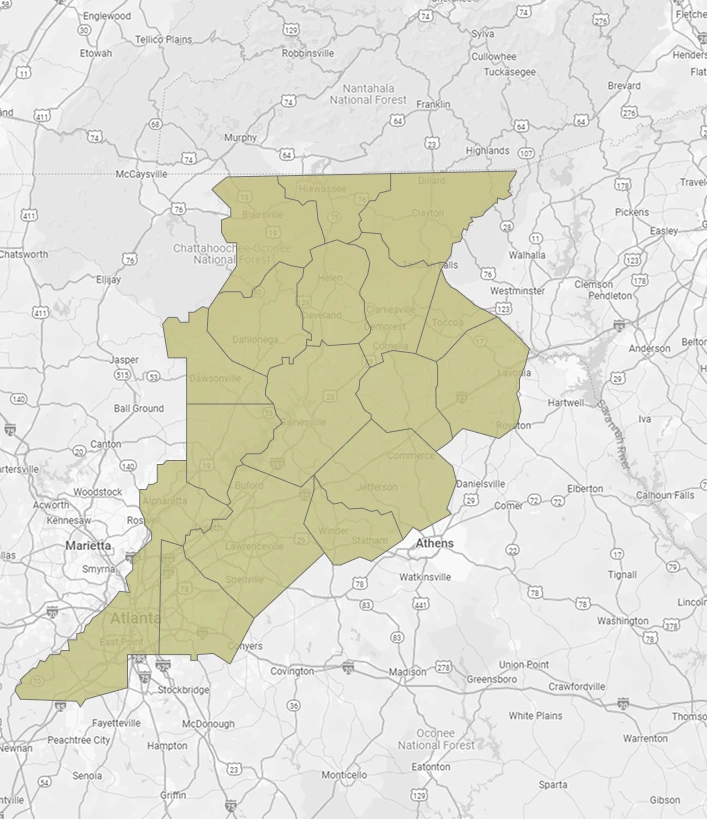
Where a Johns Creek case is heard depends on the charge and the arresting agency. Many city citations and some misdemeanors start in Municipal Court, while other misdemeanors go to State Court and felonies go to Superior Court.
The Johns Creek Municipal Court, at 11360 Lakefield Drive, Johns Creek, GA 30097, hears city code and traffic violations written inside the city limits. It also handles certain misdemeanors, including DUI, shoplifting, and possession of less than an ounce of marijuana.
Johns Creek is in Fulton County, so misdemeanor charges are heard in Fulton County State Court. Felony charges belong to Fulton County Superior Court, part of the Atlanta Judicial Circuit. According to Fulton County, misdemeanors in State Court are handled by the Fulton County Solicitor-General, and felonies in Superior Court are handled by the Fulton County District Attorney.
What a Conviction Can Cost You

A conviction reaches well past the sentence a judge hands down. In a city of 82,453 residents (2020 Census), a record can follow you into every background check. These are the costs a Johns Creek criminal defense attorney works to keep off your record.
#spoilers_start
Your Record and Your Job
A criminal record shows up on background checks for employers, schools, and professional licensing boards long after the case closes. Nurses, teachers, and real estate agents may also be required to report an arrest to their licensing board.
Your Driver's License
Many charges, DUI first among them, can put your license at risk. Losing it can make work and family duties hard to manage across North Fulton.
Your Rights as a Citizen
Some convictions affect firearm rights. For people who are not U.S. citizens, a conviction can carry immigration consequences.
Your Home and Family
A record can complicate rental applications and custody matters. It can also strain the trust of people who rely on you.
#spoilers_end
DUI Charges in Johns Creek
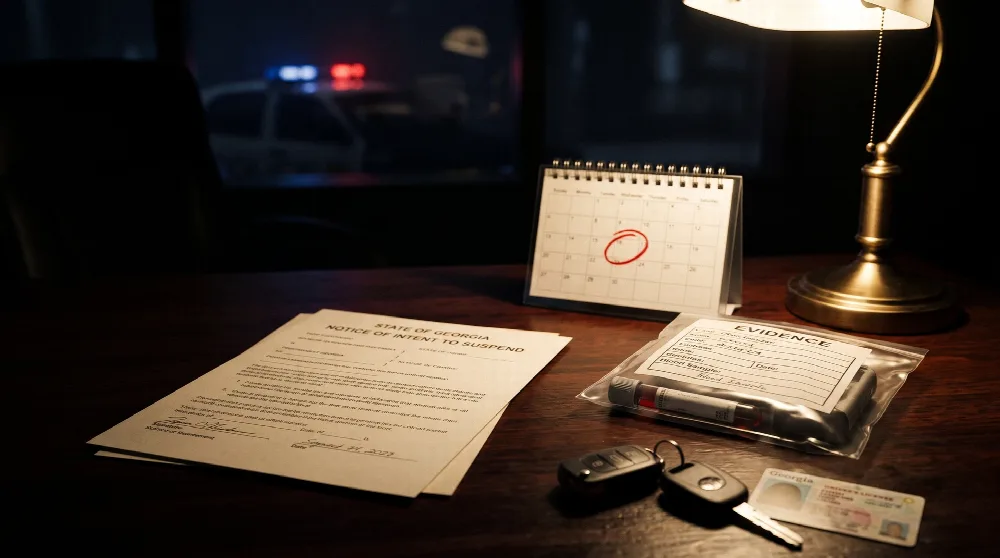
A DUI arrest starts two cases at once: the criminal charge and a separate fight over your license. Each one needs its own defense from a Johns Creek criminal defense attorney.
#spoilers_start
The Stop and the Arrest
Every DUI defense starts with whether the officer had a lawful reason to stop the car and to make the arrest. A stop without a lawful basis can undo the evidence that follows. Under O.C.G.A. § 40-6-391, the legal limit is 0.08 for most drivers, 0.04 while operating a commercial motor vehicle, and 0.02 for drivers under 21.
The 30-Day License Deadline
If you refused testing or tested over the limit, the officer serves a notice of intent to suspend your license, usually at the arrest. From that notice, you have 30 days to request an Administrative License Suspension hearing by filing a $150 fee. That deadline runs apart from the criminal case. The rule sits in O.C.G.A. § 40-5-67.1, and the Georgia Department of Driver Services handles the license side.
Breath and Blood Test Evidence
We request the breath or blood test records and check how the test was given. A test the State cannot stand behind weakens its case.
#spoilers_end
Diversion and First Offender Options

Not every case has to end in a conviction. Georgia offers paths that can keep a first mistake from defining you.
Pretrial Diversion
For first-time drug possession, Georgia law also provides conditional discharge under O.C.G.A. § 16-13-2. It follows a guilty plea or finding, and the charge is dismissed without a conviction once the court’s terms are completed.
First Offender Treatment
Georgia's First Offender Act, found at O.C.G.A. § 42-8-60, can allow a person with no prior felony conviction to complete a sentence without a conviction entered. It can be used only once, and it is not available for DUI, serious violent felonies, or sexual offenses. We review whether it fits your case before discussing any plea. Since July 2026, first offender records are sealed when the sentence is entered rather than after it is completed.
Your Constitutional Rights Are Defense Tools
The Constitution limits what police and prosecutors may do. The Law Offices of Blake A. Poole uses any violation of your rights to weaken the case against you.
Unlawful Searches and the Fourth Amendment
Evidence taken in a search without a warrant, valid consent, or another lawful basis can be challenged. If the court agrees, that evidence can be excluded from the case.
The Right to Stay Silent and the Fifth Amendment
You do not have to answer police questions. Statements taken in violation of that right can be challenged.
The Right to Counsel and the Sixth Amendment
You have the right to an attorney. Asking for one is not an admission of anything.
Get a Defense Plan for Your Charge
Knowing which court holds your case tells the defense which prosecutor it faces and which deadlines apply first. The Law Offices of Blake A. Poole will review your paperwork and explain your options.